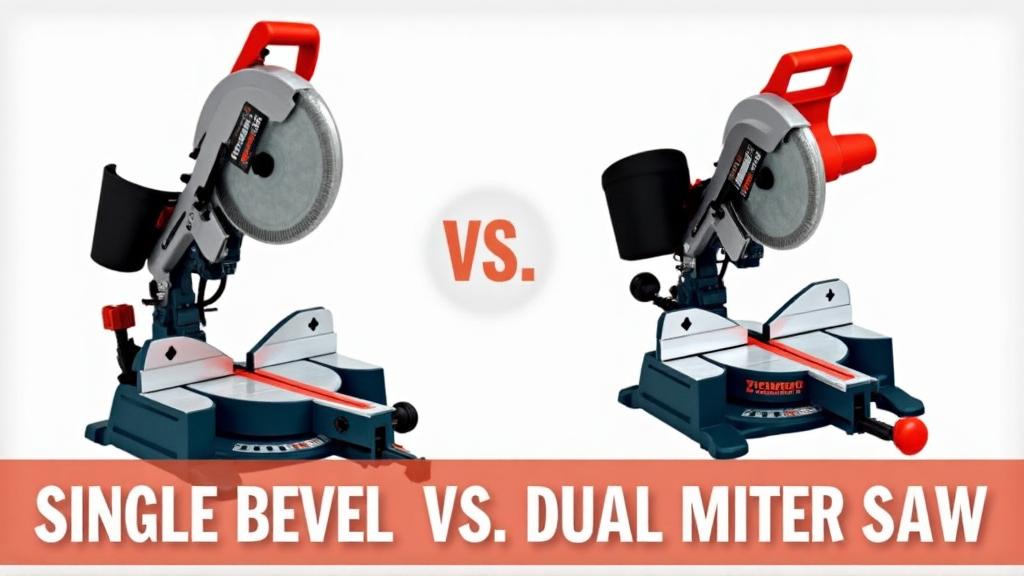
Choosing between a single bevel and a dual bevel (also called double bevel) miter saw depends on how you plan to use the saw’s tilting head. Both types cut miters (angles across the face of the board) and bevels (angles along the edge), but they differ in which direction the saw head can tilt. This comparison covers the key differences, a side-by-side matrix, and guidance on which option suits typical woodworking tasks.
A single-bevel miter saw can tilt the blade in only one direction, usually to the left, or less commonly, to the right. To make a bevel cut in the opposite direction, you must flip the workpiece or reposition the saw. A dual-bevel miter saw can tilt both left and right, allowing bevel cuts in either direction without flipping the material.
The main tradeoff is convenience versus cost. Single-bevel saws are generally less expensive, but they can slow you down when a project requires bevel cuts on both sides of a workpiece. Dual-bevel saws cost more but save time and reduce the chance of misalignment on compound cuts (which combine a miter and a bevel).
Comparison Matrix
| Criterion | Single Bevel Miter Saw | Dual Bevel Miter Saw |
|---|---|---|
| Bevel direction | Tilts in one direction only (left or right) | Tilts both left and right |
| Typical cost | Lower upfront price | Higher upfront price |
| Convenience for compound cuts | Requires flipping workpiece or repositioning to cut opposite bevel | Can cut both bevel directions without repositioning |
| Best for | Occasional bevel cuts, DIY home projects, budget-conscious buyers | Frequent bevel or compound cuts, trim carpentry, production work |
When to Choose Each Option
Choose a single-bevel miter saw if:
- Your projects rarely require bevel cuts (e.g., basic framing, rough cutting, or simple mitered corners).
- You are on a tighter budget and want to minimize upfront cost.
- You are willing to flip the workpiece or walk around the saw when a bevel cut is needed on the opposite side.
Choose a dual-bevel miter saw if:
- You frequently make compound cuts (e.g., crown molding, picture frames, or stair stringers).
- You work in a production setting or need to cut multiple pieces quickly without repositioning.
- The added convenience justifies the higher price, and you want to avoid the risk of error from flipping the material.
Bottom Line
Both single-bevel and dual-bevel miter saws can handle the same basic cuts, but the dual-bevel version offers greater convenience for bevel work on both sides of a workpiece. If you rarely need bevel cuts, a single-bevel saw is a cost-effective choice. If you regularly cut crown molding, trim, or other compound angles, the extra expense of a dual-bevel model is likely worth it.
References Double Bevel vs Single Bevel Miter Saw: Full Comparison – https://www.youtube.com/watch?v=7zWaCrg2lPM&vl=en-US Single Bevel or Double Bevel Miter Saw – https://forum.mrhmag.com/post/single-bevel-or-double-bevel-miter-saw-12216627 Miter Saw Buying Mistakes: How-To Choose The Right Saw The First Time – https://www.acmetools.com/tool-crib/ac548272/miter-saw-buying-mistakes-how-to-choose-the-right-saw-the-first-time What's the difference between miter saw types? – https://www.facebook.com/groups/woodworkingforbeginner/posts/3461962723958328 Single vs Double Bevel Miter Saw – https://www.thehandymansdaughter.com/single-vs-double-bevel-miter-saw Single Bevel vs Double Bevel Miter Saw: Which One is Right for You? – https://www.youtube.com/watch?v=w8-Or6nNe6U For DIY home use, do you recommend a single or dual bevel miter saw? – https://www.quora.com/For-DIY-home-use-do-you-recommend-a-single-or-dual-bevel-miter-saw Single or Double Bevel Miter Saw – https://www.lumberjocks.com/threads/single-or-double-bevel-miter-saw.15163