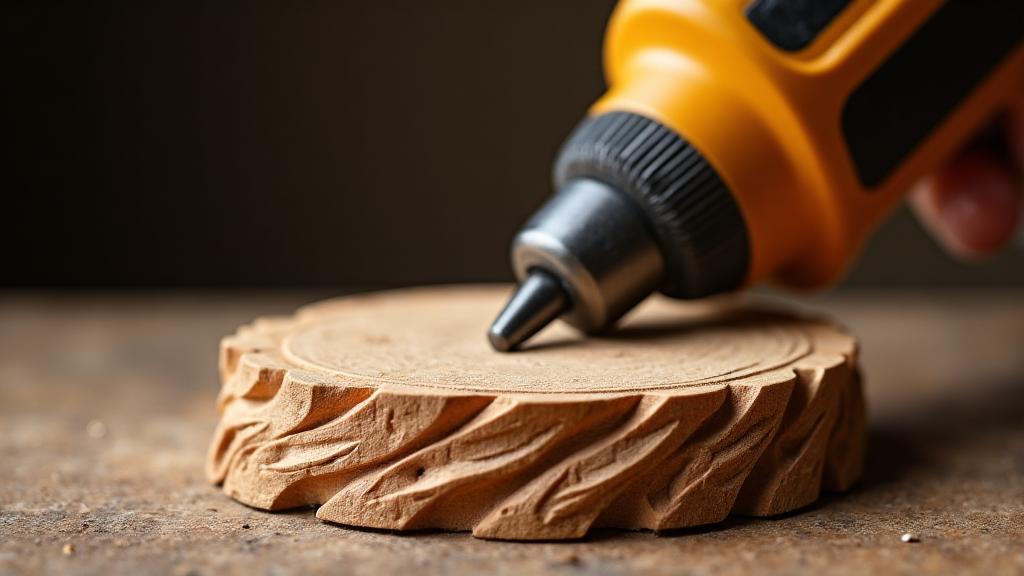
Quick answer: Wood carving power tools fall into two main action types: rotary (spinning) and reciprocating (pushing/pulling). Rotary tools include flexible-shaft systems (e.g., Foredom, Wecheer) and hand-held units (e.g., Dremel), while reciprocating tools use a chisel-like motion. For heavy shaping, angle-grinder attachments from Arbortech or King Arthur's Tools are commonly used. Your choice depends on the scale of work, required precision, and budget.
Main explanation
How power carving tools work
Rotary carving units use a motor to rotate a spindle. They range from small hand-held pens to larger suspended units with a flexible shaft, which separates the motor from the handpiece to reduce fatigue and improve control. Reciprocating power tools use a back-and-forth motion similar to a chisel, generating less dust than rotary tools.
Types of power carving tools
- Rotary with flexible shaft: These are often used in industrial settings. Brands like Foredom and Wecheer are built for durability and are commonly found in professional workshops. They are suitable for carving, engraving, and polishing.
- Hand-held rotary tools: Smaller, all-in-one units often seen in DIY stores. They are lighter but may overheat during extended use.
- Angle-grinder attachments: Arbortech offers a Power Carving Unit Woodworking Tool (RRP $299.00, sale $249.00) and TURBOPlane disc for rapid material removal. King Arthur's Tools provides over 500 power carving and woodworking tools and accessories.
- Reciprocating chisels: Foredom and Wecheer also offer reciprocating handpieces for their flexshaft tools, and dedicated tools like the Arbortech Power Chisel are available for large projects.
Decision framework: Choose the right power carving tool
Follow these ordered steps to select the tool that matches your project:
1. Define your carving task
- Rough shaping and fast material removal? → Consider angle-grinder attachments (Arbortech, King Arthur).
- Fine detail and controlled carving? → Rotary with flexible shaft (Foredom, Wecheer) or a hand-held rotary.
2. Choose the power source
- For sustained use and reduced fatigue: flexible-shaft rotary unit.
- For occasional or light work: hand-held rotary tool.
3. Select the cutting action
- Rotary for grinding, sanding, and carving.
- Reciprocating for chip carving without dust.
4. Set a budget
- Entry-level hand-held rotary tools are affordable but may lack power for large projects.
- Industrial flexible-shaft kits (Foredom, Wecheer) cost more but offer durability.
- Angle-grinder attachments vary in price; Arbortech's Power Carving Unit is $249.00 on sale.
5. Check for compatibility
- Ensure the tool accepts the accessories you need (cutters, discs, burrs). Many systems have proprietary connections.
Practical takeaways
- For most woodcarvers, a flexible-shaft rotary system from Foredom or Wecheer provides a good balance of power and control.
- If you are starting out, a hand-held rotary tool can be enough for small projects, but be prepared for potential overheating during extended use.
- For large-scale shaping, angle-grinder attachments from Arbortech or King Arthur's Tools can save time.
- Reciprocating tools are a good alternative if you want to avoid dust.
References Guide to Choosing Tools for Rotary Power Carving - https://woodworkersinstitute.com/power-carving Power Carving - https://www.arbortechtools.com/us/shop-online/power-carving Power Woodcarving Tools - https://www.chippingaway.com/cat/power-woodcarving-tools King Arthur's Tools Woodworking and Power Carving - https://katools.com
Note: This article is based on desk research from the provided sources and does not include hands-on testing.